

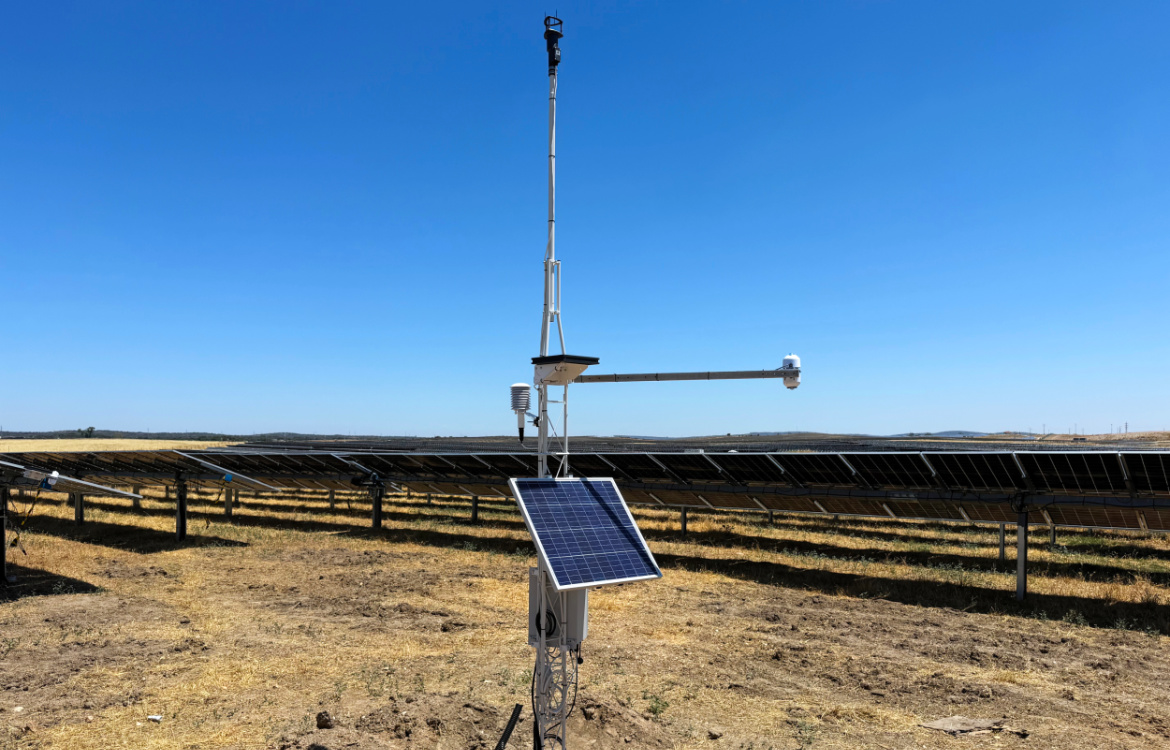
The new stations measure the available solar resource, including plane-of-array irradiance, along with key weather variables at the site. Integrated into the plant’s SCADA system, the data gives the client a clear picture of operating conditions and a solid basis for assessing plant performance.
At a photovoltaic plant, energy production depends directly on solar irradiance and the environmental conditions to which the modules are exposed. Accurate, reliable field measurements are therefore essential for evaluating how the plant is performing. To support this, Darrera has installed three 3R AWS100-PV high-performance weather stations at different locations across the site to monitor the solar resource and key weather variables. The stations are solar-powered and can operate autonomously without a grid connection. They are also mounted on tilt-down masts that make the instruments easier to access during routine maintenance.
All three stations share a common base configuration consisting of an ultrasonic anemometer, a combined temperature and humidity sensor with a radiation shield, a tipping-bucket rain gauge, and a calibrated reference cell. This common setup promotes measurement consistency and makes it easier to compare data across stations. Two of the stations also feature dedicated instrumentation to characterize the solar radiation reaching the modules in greater detail. Mounted on the solar trackers are a POA (Plane of Array) pyranometer, which measures irradiance in the plane of the modules and provides a key reference for relating the solar resource to energy output, and an RPOA (Rear Plane of Array) pyranometer, which measures irradiance reaching the rear side of the modules. An additional cell and a panel temperature probe are also installed on the trackers, providing further insight into module operating conditions. The installation also includes an EKO MS-90 Plus+ solar monitoring system, which measures direct normal and global horizontal irradiance and calculates diffuse horizontal irradiance. An albedometer separately measures the reflectivity of the surrounding surface, supporting the analysis of reflected solar radiation.
Data collected by the stations is transmitted to the plant’s SCADA system, where it is integrated into the monitoring environment. This allows operations staff to access and analyze the measurements alongside other plant data. Irradiance measurements, particularly in the plane of the modules, together with panel temperature and key weather variables, help characterize module operating conditions and compare plant output with the available solar resource. As a result, the client has an objective, on-site reference for assessing the performance of the PV plant.
Through this project, Darrera reinforces its position as a provider of customized monitoring solutions for the photovoltaic sector. The solution combines precision instrumentation, data acquisition, and integration with plant systems in a configuration built around the client’s specific requirements.